

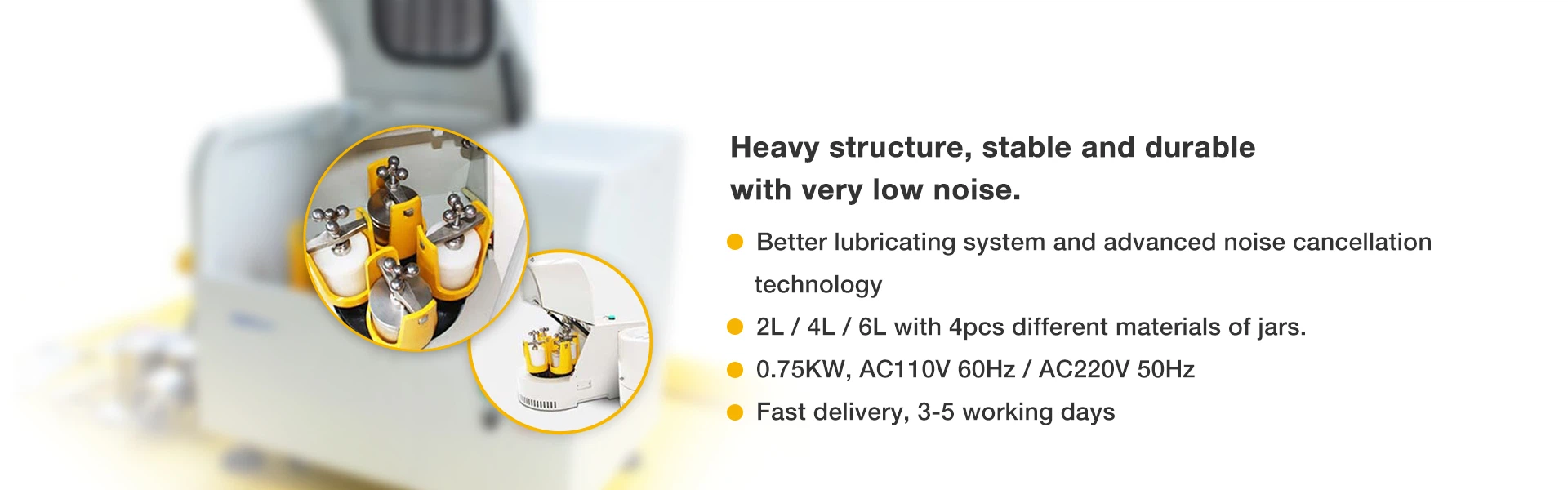
Laboratory Ball Mill for Cement Powder, Mineral Additives and Concrete Material Research
In the research and development process of cement and building materials, powder preparation is an important link that affects the analysis of material properties. Whether it is cement clinker, mineral additives, or concrete related materials research, reliable laboratory grinding and homogenization treatment are required to obtain representative test samples

For Cement Manufacturers, Building Material Research Institutes, and University Laboratories, the experimental phase typically involves:
- Cement powder preparation
- Clinker grinding
- Mineral additive analysis
- Concrete material research
These experiments have raised high requirements for the quality of the powder:
- Controlled particle size
- Uniform powder distribution
- Repeatable grinding results
- Stable sample preparation
Therefore, a laboratory ball mill for cement suitable for research and testing environments not only needs to complete material crushing, but also needs to help researchers establish a stable testing process.
DECO focuses on the research and development of laboratory ball mills, planetary ball mills, and powder processing equipment, providing laboratory grinding solutions for building materials, cement, ceramics, minerals, and new materials research. The DECO planetary grinder generates strong impact and friction forces through planetary motion, and can be used for fine grinding, mixing, and homogenization of samples such as cement powder, mineral materials, and concrete raw materials.(deco-ballmill.com)

01 Cement & Building Material Research Overview
Powder Preparation Determines Testing Accuracy
Although cement and building materials belong to traditional industrial fields, with the development of high-performance concrete, green building materials, and low-carbon cement technology, material research and development have put forward higher requirements for experimental accuracy.

Research on modern building materials involves:
- High-performance concrete
- Supplementary cementitious materials
- Low-carbon cement
- Advanced construction composites
These material properties are usually closely related to the powder state.
For example:
The particle size of cement will affect:
- Hydration reaction
- Setting time
- Strength development
The particle size of mineral admixtures will affect:
- Filling effect
- Pozzolanic activity
- Concrete durability
Therefore, before material testing, it is necessary to process the raw materials into:
- Uniform fine powder
- Representative sample
- Stable analytical material
Why Ball Milling Is Used in Cement Testing?
Traditional industrial ball milling equipment is mainly used for large-scale production, while laboratory research pays more attention to it:
- Small sample preparation
- Formula comparison
- Material performance evaluation
The laboratory ball milling process can be completed:
1. Particle Size Reduction
Reduce:
- Cement clinker particles
- Mineral particles
- Aggregate powder
Improve:
- Surface area
- Reaction activity
- Mixing performance
2. Powder Homogenization
Building materials typically contain multiple components:
For example:
Cement:
- Clinker
- Gypsum
- Mineral additives
Concrete:
- Cement powder
- Fly ash
- Slag powder
- Silica materials
If the powder mixing is not sufficient, it will affect:
- Test accuracy
- Strength evaluation
- Material comparison
3. Sample Preparation for Material Testing
The ground powder can be used for:
- Chemical analysis
- Particle size analysis
- Mineral composition testing
- Hydration research
The DECO planetary grinding machine is suitable for laboratory material research. By high-speed movement of the grinding tank, the grinding balls collide and rub, achieving powder refinement and uniform mixing.(deco-ballmill.com)

02 Building Materials Requiring Ball Milling
1. Cement Powder Processing Solution
Laboratory Ball Mill for Cement Powder Preparation
Cement powder is the most common experimental object in the research of building materials.
The main materials include:
- Portland cement
- Cement clinker
- Special cement materials
Cement experiments usually require research:
- Particle size distribution
- Hydration behavior
- Strength development
Cement Grinding Requirements
Fine Grinding
The performance of cement is closely related to its fineness.
Finer particles can improve:
- Early hydration reaction
- Contact area with water
- Strength development speed
Uniform Particle Distribution
Influence of particle size distribution:
- Packing density
- Water demand
- Workability
DECO laboratory ball mill for cement can assist researchers in processing small batches of cement powder for formula optimization and material performance research.

2. Cement Clinker Grinding Solution
Ball Mill for Clinker Research
Cement clinker is the core material in the cement production process.
The main components include:
- C3S
- C2S
- C3A
- C4AF
Research on clinker grinding focuses on these parameters:
- Grinding efficiency
- Powder fineness
- Mineral phase analysis
Laboratory ball milling can help with research:
- Different grinding conditions
- Effects of different grinding aids
- Changes in clinker performance
The DECO planetary grinding machine supports both dry and wet grinding modes, and the processing method can be adjusted according to the experimental purpose. (deco-ballmill.com)
Mineral Additives Processing Solution
Grinding Equipment for Cement Additives
Modern cement extensively uses mineral admixtures to reduce costs and improve performance

Common Materials:
- Fly ash
- Slag
- Silica fume
- Limestone powder
These materials need to be studied:
- Particle size
- Activity
- Dispersion
Fly Ash Grinding Research
After ball milling fly ash:
- Particle size decreases
- Surface activity increases
- Dispersion improves
Suit for:
- High-performance concrete research
- Cement replacement studies
Slag Powder Preparation
The research on slag powder focuses on the following parameters:
- Fineness
- Reactivity
- Compatibility with cement
DECO equipment can be used for laboratory powder preparation of mineral admixtures, providing stable samples for subsequent performance testing.
4. Concrete Material Research Solution
Ball Milling for Concrete Materials
Concrete research not only involves cement, but also includes:
- Fine aggregates
- Mineral fillers
- Functional additives
Experimental research direction:
- Strength improvement
- Durability enhancement
- Sustainable concrete development
Ball milling treatment can improve:
- Powder dispersion
- Material blending
- Experimental consistency
The DECO planetary grinder is suitable for small batch material processing in building materials laboratories. The application areas of DECO products include building materials, ceramics, minerals, chemicals, and environmental protection.(deco-ballmill.com)
03 Grinding Requirements for Cement Materials
1. Controlled Particle Size
Adjusting Cement Powder Fineness
In cement research, particle size control directly affects:
- Hydration rate
- Strength performance
- Material stability
Influencing factors:
| factor | effect |
|
Grinding speed |
Affects impact energy |
|
Grinding time |
Determine the fineness of the powder |
|
Grinding media |
Affects grinding efficiency |
|
Jar material |
Impact pollution level |
|
Material loading |
Influence uniformity |
The DECO laboratory planetary grinder supports stepless speed regulation and can adjust experimental parameters according to different materials. Some models can achieve a particle size of 2-10 μ m for most materials, and some materials can further reach about 0.1 μ m, depending on the material properties.(deco-ballmill.com)
2. Mineral Additive Activation
Improving Supplementary Material Activity
Some mineral materials require mechanical activation.
- For example:
- Fly ash
- Slag
- Natural minerals
Produced during ball milling process:
- Particle refinement
- Surface activation
- Structural change
Assist researchers in evaluating:
- Pozzolanic reaction
- Cement compatibility
3. Powder Mixing and Homogenization
Preparing Uniform Cement Composite Materials
Modern building materials typically use composite systems:
For example:
- Cement + Fly ash
- Cement + Slag
- Cement + Nano additives
Need to ensure:
- Uniform composition
- Stable distribution
The DECO planetary grinding machine uses high-energy mixing to ensure full contact between different powders and improve the consistency of experimental samples.
4. Low Contamination Sample Preparation
Protecting Material Analysis Accuracy
Although building material testing is not as extremely sensitive as electronic materials, it is important for:
- Chemical analysis
- Mineral phase analysis
- Research comparison
- Still need to control pollution
DECO offers a variety of grinding jar options:
- Stainless steel
- Zirconia
- Alumina ceramic
- Agate
- Tungsten carbide
Meet different testing requirements.(deco-ballmill.com)

5. Small Batch Testing
Flexible Laboratory Material Research
The research and development of building materials usually requires:
- Comparison of multiple formulas
- Small batch testing
- Rapid experimental verification
Compared to industrial equipment, the advantage of laboratory ball mills lies in:
- Sample volume flexibility
- Easy parameter adjustment
- Faster material switching
The DECO 0.4L laboratory planetary grinder is suitable for desktop experimental environments and can be installed with multiple grinding tanks for testing different materials simultaneously. (deco-ballmill.com)

04 DECO Cement & Building Material Testing Solution
Laboratory Ball Mill for Cement Research
DECO provides experimental services for building materials:
- Mini planetary ball mill
- Laboratory planetary ball mill
- Grinding jar solutions
- Customized configurations
1. DECO Mini Laboratory Planetary Ball Mill
Suit for:
- Cement powder research
- Mineral additive testing
- Concrete material analysis
Feature:
- Compact design
- Small batch processing
- Low noise operation
DECO-PBM-V-0.4L support:
- 2 or 4 grinding jars working simultaneously
- Dry grinding and wet grinding modes
- Multiple choices of grinding jar materials
(deco-ballmill.com)
2. Laboratory Planetary Ball Mill
Suit for:
- Cement manufacturers
- Research institutes
- Universities
Application:
- Cement powder preparation
- Mineral additive research
- Construction material testing
3. Heavy Duty Grinding Solution
Targeted at:
- Hard clinker
- Mineral materials
- Ceramic additives
The DECO enhanced planetary grinding machine adopts a reinforced structural design, which is more suitable for matching:
- Zirconia jars
- Stainless steel jars
- Cemented carbide jars
Perform high-intensity grinding.(deco-ballmill.com)

4. Customized Cement Material Grinding Configuration
DECO provides based on material characteristics:
|
Application |
Recommended Configuration |
|
Cement powder testing |
Stainless steel jar |
|
Mineral additive research |
Zirconia/Alumina jar |
|
High purity analysis |
Agate jar |
|
Hard clinker grinding |
Cemented carbide jar |
05 Grinding Jar Selection

Choosing the Right Grinding Jar for Cement Materials
The influence of grinding jar selection:
- Grinding efficiency
- Sample purity
- Testing accuracy
Stainless Steel Grinding Jar
Suit for:
- Cement powder
- Clinker
- General building materials
Advantage:
- Strong durability
- Cost-effective

Zirconia Grinding Jar
Suit for:
- Mineral additive research
- High purity testing
Advantage:
- High hardness
- Low wear

Alumina Ceramic Jar
Suit for:
- Ceramic-based building materials
Advantage:
- Chemical stability
- Good wear resistance

Agate Grinding Jar
Suit for:
- Precise material analysis
Advantage:
- Minimal contamination

Why Choose DECO Cement & Building Material Testing Solution?
DECO focuses on the research and manufacturing of laboratory ball milling equipment, providing powder processing equipment for global research institutions, enterprise laboratories, and material development teams. DECO laboratory ball mills are widely used in:
- Construction materials
- Cement research
- Ceramics
- Geology
- Chemistry
- New materials
- (deco-ballmill.com)
For Cement&Building Material Research, DECO provides:
- Cement powder grinding
- Mineral additive preparation
- Concrete material testing
- Laboratory sample homogenization
- Core Advantages:
- High energy grinding performance
- Flexible grinding jar selection
- Small batch research capability
- Repeatable testing process
The research and development of cement and building materials is moving towards high performance and low carbonization, and the powder processing in the laboratory stage determines the reliability of subsequent test data.
DECO laboratory ball mill for cement provides a reliable laboratory preparation solution for the research of cement powder, mineral admixtures, and concrete materials through stable mechanical grinding ability.
