

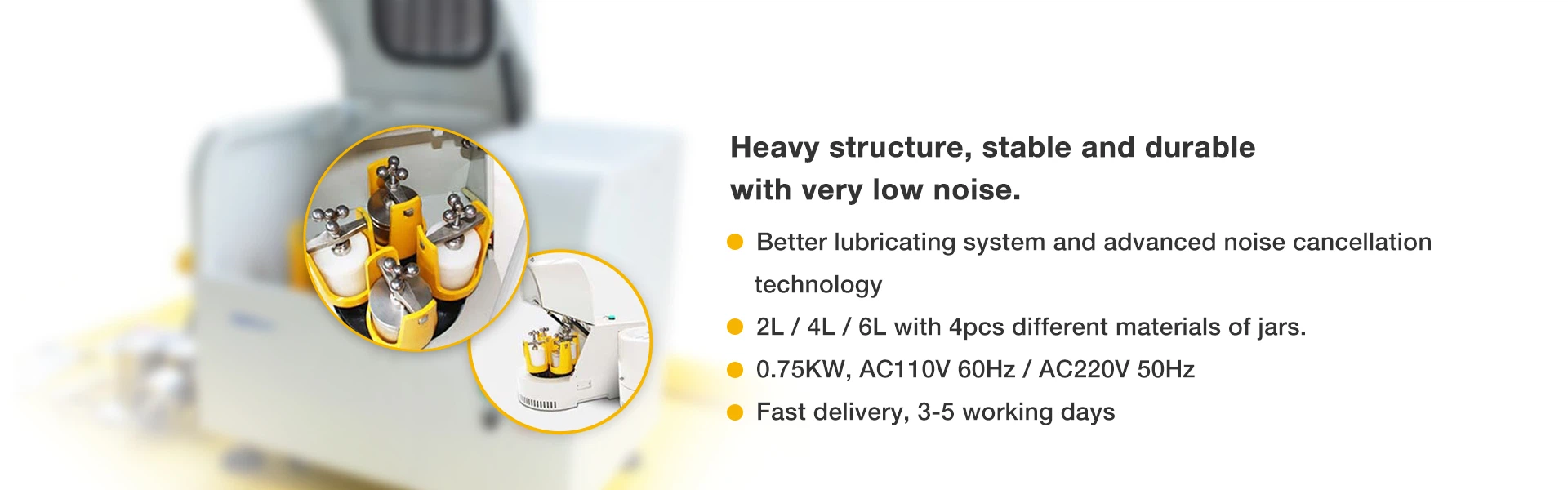
Experienced planetary ball mill/jar roller mill manufacturer ,Powder expert,High quality and high service,Support customized services,Your trusted partner in China!
Jar Roller mills are workhorses for coarse grinding in mining, cement, and bulk chemical industries. Their strength lies in high-volume processing and durability, Always match drum size, media type, and RPM to your material hardness and target fineness!

-

This product is used for sample experiments with the purpose of grinding, mixing and homogenizing,can grind sample to 300-500 mesh
Add to Inquiry -
Laboratory Jar Mill with 2 Milling Jars
Lab roll ball mill is a kind of equipment used for ultrafine grinding and mixing for laboratory and small batch production, which is also called rolling mill.
Add to Inquiry -
Lab Roller Ball Mill 4*5L With Safety Cover
The safety cover is added to the original design of the product, which increases the safety of production.
Add to Inquiry -
Laboratory Roller Jar Mill With Safety Cover
This is a laboratory roller jar mill with a protective cover, which can help to mix, mix, grind samples, and design the protective cover, making it more user-friendly and safe.
Add to Inquiry -
5L lab grinding mill Introduction: The DECO Lab ball mill is a kind of sample pulverizing machine, which can grind coarse particles into micro powders. It can mill the materials from 10mm maximum
Add to Inquiry -
20L ball mill lab experiment A horizontal cylinder is rotated at a predetermined speed that sets the balls into a tumbling and cascading motion which impact the solids in a very predictable and
Add to Inquiry -
Laboratory Jar Ball Mill INTRODUCTION: When lab jar ball mill works, the grinding media and the materials in the jars raise to a certain height. Due to the gravity, they fall down from the tube wall.
Add to Inquiry -
Lab Ball Milling Machine Roller
Lab Ball Milling Machine Features: Small horizontal jar mill mainly used in the laboratory and small batch production.Because of the flexible and convenient operation,also used for production of some
Add to Inquiry -
Mini Roll Laboratory Ball Mill
Mini Roll Laboratory Ball Mill 1. Compact structure, easy operation 2. High efficiency and uniform granularity 3. Milling pot in different size can be put on the roller within a certain range by
Add to Inquiry -
The DECO Laboratory ball mill is a kind of sample pulverizing machine, which can grind coarse particles into micro powders. It can mill the materials from 10mm maximum into 10um minimum powder. This
Add to Inquiry -
Ideal for R & D and small production runs, for laboratory sample grinding or mixing Single or multi-tier design, two or four ball grinding jars per tier Jars of different sizes and materials can
Add to Inquiry -
Lab Mineral Grinding Ball Mill
Ideal for R & D and small production runs, for grinding laboratory or high-purity samples Single or multi-tier design, two or four ball grinding jars per tier Jars of different sizes and
Add to Inquiry


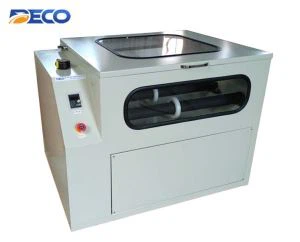


Lab Jar Roller Mills are designed to crush medium, hard and soft powdery materials to powder.
Ball mills depending on the number of working stations: one station ball mill, two station ball mill and more station ball mills.
Various kinds of materials can be ground by the mill with dry or wet method.
The lab ball mill grinds materials by rotating a jar with balls causing the balls to fall back into the jar and onto the materials, thus grinding or dispersing the materials.
Technical Parameter
(1) Single direction without timing
Samples need long or non-stop milling.
(2) Single direction with timing
Samples need to be milled in one direction for a designated amount of time before automatic shutdown.
(3) Bi-direction with timing
For example: samples need to run clockwise for 1.5 hours, then counter-clockwise for another 1.5 hours and so on, for 15 total hours, before the machine shuts down itself.
(4) Single direction with paused interval and timing
For example: samples need to run for 0.5 hour, then pause for 1 hour, then run for another 0.5 hour in the same direction and pause for another 1 hour, for 10 cycles before auto shutdown.
(5) Bi-direction with paused interval and timing
For example: samples need to run clockwise for 0.8 hour, pause for 0.5 hour, then run counter-clockwise for 0.8 hour, for 20 cycles, before auto shutdown.
Working Principle
Horizontal rotation of the jar causes grinding media to roll and cascade under gravity, applying compression + shear forces to materials.
Suitable Materials:
Dry grinding (ceramic powders, metal powders).
Wet grinding (slurries, nanoparticle dispersion).
Output Particle Size: Typically 1–100μm (coarser than planetary ball mills but with higher throughput).
Key Features & Advantages
Feature | Advantage |
Horizontal Drum | Stable operation, ideal for prolonged continuous use (e.g., 24/7 runs). |
Large Capacity | Batch processing up to 20L, suitable for pilot-scale or small production. |
Low Energy Use | More energy-efficient than planetary ball mills (relies on rolling friction). |
Low Noise | Noise <65 dB, suitable for lab environments. |
Easy Maintenance | Jars are quickly detachable for cleaning; media replacement is simple. |
Typical Applications
Industry | Application Example | Recommended Media |
Ceramics | Alumina, silicon nitride powder refinement | Zirconia balls (Ø5–10mm) |
Battery | Mixing cathode/anode materials (LFP, NCM) | Stainless steel balls |
Pharmaceutical | Drug powder homogenization | Polyurethane balls |
Food | Chocolate slurry, spice blending | Ceramic balls (food-grade) |
Mining | Ore sample prep (down to 100μm) | High-chromium steel balls |
Comparison with Vertical/Planetary Ball Mills
Aspect | Horizontal Jar Roller Mill | Vertical Ball Mill | Planetary Ball Mill |
Mechanism | Rolling + shear | Gravity + impact | High-energy centrifugal impact |
Particle Size | 1–100μm | 10–300μm | 0.1–10μm (nanoscale) |
Capacity | Large (1–20L/jar) | Medium (0.5–5L) | Small (50mL–2L) |
Energy Use | Low | Medium | High |
Best For | Pilot-scale, viscous materials | Coarse grinding, mining | Ultrafine/nano grinding |
Selection & Operation Tips
Key Selection Parameters
Jar Material: Choose based on corrosion resistance (e.g., PTFE-lined for acidic/alkaline conditions).
Speed Range: Typically 20–80 RPM (use <40 RPM for viscous materials).
Grinding Media:
Hard materials (e.g., ceramics) → Zirconia balls
Contamination-sensitive (e.g., pharma) → Polyurethane/ceramic balls
Operational Guidelines
Loading: Material + media ≤ 1/3 of jar volume (overfilling reduces efficiency).
Wet Grinding: Liquid content 30–50% (avoid excessive dilution).
Cleaning: Thoroughly clean after each use to prevent cross-contamination.
Common Issues & Solutions
Issue | Possible Cause | Solution |
Low grinding efficiency | Insufficient media or oversized balls | Increase media quantity or use smaller balls |
Jar leakage | Worn seal or loose locking | Replace O-ring, check clamp |
Abnormal noise | Dry bearings or misalignment | Lubricate bearings, balance drum |
What is the application of jar roller mill?
Industry-Specific Applications
1. Materials Science & Nanotechnology
Nanomaterial Synthesis:
Dispersion and exfoliation of graphene, carbon nanotubes, and quantum dots (wet grinding).
Example: Zirconia jars + ZrO₂ balls for graphene slurry to produce monolayers (<1 nm thick).
Mechanical Alloying:
High-energy ball milling of metal powders (e.g., Al-Ti, Cu-Zn) to create novel alloys.
2. Energy & Batteries
Lithium Battery Materials:
Homogenization and particle size control of cathode materials (LiFePO₄, NCM; target: 1–10 µm).
Example: Nylon jars prevent metal contamination during wet grinding of electrode slurries.
Solid-State Electrolytes:
Ultrafine grinding of LLZO (Li₇La₃Zr₂O₁₂) ceramic powders to submicron levels.
3. Pharmaceuticals & Biotechnology
Drug Micronization:
Improving bioavailability of poorly soluble drugs (e.g., nano-ibuprofen).
Example: Polyurethane jars for cryogenic grinding of heat-sensitive proteins.
Cell Disruption:
Mechanical lysis of yeast/bacterial cells (requires sterile zirconia jars).
4. Mining & Metallurgy
Ore Pre-Treatment:
Fine grinding of gold/rare earth ores (50–100 µm) to enhance leaching efficiency.
Example: Tungsten carbide jars for high-hardness ores (Mohs ≥8).
Metal Powder Production:
Spheroidization of Ti/W powders (under inert gas).
5. Ceramics & Construction
Ceramic Powder Refinement:
Grinding alumina/silicon nitride to 0.5–5 µm for improved sintering.
Cement Additives:
Activation grinding of slag micropowders (surface area >500 m²/kg).
6. Food & Cosmetics
Food Ingredient Homogenization:
Mixing chocolate slurries or spice powders (food-grade stainless steel jars).
Cosmetic Ingredients:
Nanodispersion of TiO₂/ZnO (metal-free contamination).
Why choose deco company? 7 *24 hours online EMAIL service!
1. We are Alibaba Assessed Gold Supplier.
2. We are a factory manufacturing laboratory planetary ball mills, the best production capability, the best quality control and the best services.
3. 100% QC inspection before shipment.
4. CE, ISO9001 listed ball mills, competitive prices.
5. We provide just-in-time delivery with its streamlined supply chain to ensure you quick delivery.
6. We provide long-life and high reliability ball mills with excellent quality and better performance, resulting in increased cost savings.
7. We believe that if customers are satisfied then it proves our worth well. Customers are always given quick support.
FAQ
When to Choose a Jar Roller Mill?
YES if:
Target particle size > 50 μm.
Processing tons/hour of abrasive materials (e.g., ores, cement).
Budget favors low-cost, high-capacity solutions.
NO if:
Need nanoparticles (<1 μm) → Planetary ball mill.
Processing heat-sensitive biomaterials → Cryogenic bead mill.
Difference Between Jar Roller Mill & Ball Mill
A jar roller mill relies on the rolling motion of jars on rollers, while a ball mill typically involves a rotating drum where grinding occurs via cascading media.
Jar roller mills are often used for smaller batches and offer better control over mixing conditions.
When NOT to Use a Jar Roller Mill?
For ultra-fine nano grinding (planetary ball mills or bead mills are better).
Large-scale industrial production (continuous ball mills or attritors are more efficient).
Very hard materials (if grinding media can’t provide sufficient impact energy).
Experienced planetary ball mill/jar roller mill manufacturer ,Powder expert,High quality and high service,Support customized services,Your trusted partner in China!
We're professional laboratory ball mill manufacturers and suppliers in China, with the business principle of"Customer is Superior, Quality is in the First Position Forever". We warmly welcome you to buy quality laboratory ball mill for sale with competitive price from our factory.
