

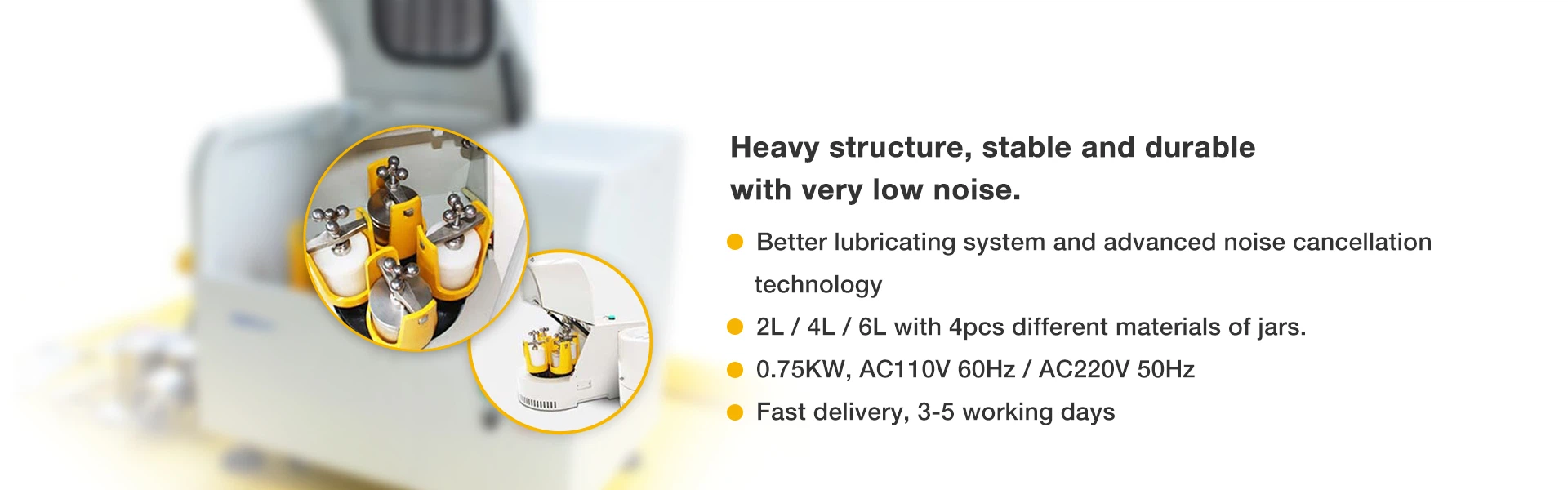
How to Choose a High-Quality Planetary Ball Mill
Mar 04, 2025
Selecting a high-quality planetary ball mill requires careful consideration of multiple factors to ensure the equipment meets experimental or production needs. Below are the key steps and considerations:
1. Define Requirements
Sample Type: Determine the properties of the samples to be ground (e.g., hardness, brittleness, moisture content).
Grinding Goals: Clarify the required particle size range, uniformity, and whether mixing or alloying is needed.
Application Scenario: Decide if the equipment is for laboratory research or industrial production. Laboratory equipment is typically smaller, while industrial equipment requires higher capacity and durability.
2. Core Parameters
Grinding Jar Volume: Choose the appropriate jar size based on sample quantity, with common volumes ranging from 50 mL to 1000 mL.
Speed Range: Higher speeds provide greater grinding energy, but ensure the samples can withstand high-energy impacts. Typical speed ranges are 100-800 rpm.
Grinding Media: Select the appropriate grinding ball material (e.g., stainless steel, zirconia, tungsten carbide) and size based on sample characteristics.
Grinding Methods: Ensure compatibility with dry grinding, wet grinding, vacuum grinding, or inert gas-protected grinding.
3. Equipment Quality
Material:
Grinding jars and balls should be corrosion-resistant and wear-resistant, with common materials including stainless steel, zirconia, and polyurethane.
The equipment housing and structural components should be sturdy and durable.
Motor Performance: The motor should be stable, reliable, and capable of long-term operation with low noise.
Sealing: For wet or vacuum grinding, the equipment's sealing is crucial to prevent leaks or contamination.
4. Control System
Automation Level: High-quality equipment typically features a programmable control system, allowing settings for speed, time, and rotation direction.
Safety Features: Ensure the equipment includes overload protection, emergency stop functions, and other safety mechanisms.
User Interface: The interface should be intuitive and user-friendly, with support for data recording and storage.
5. Brand and After-Sales Service
Brand Reputation: Choose well-known brands or suppliers with proven market experience to ensure quality and performance.
After-Sales Service: Check if the supplier provides technical support, maintenance services, and spare parts availability.
Warranty: Confirm the warranty period and coverage.
6. Budget and Cost-Effectiveness
Price Range: Planetary ball mills can range from a few thousand to hundreds of thousands of yuan. Select a product that fits your budget.
Cost-Effectiveness: Choose equipment that offers stable performance and reasonable pricing, avoiding unnecessary high-end configurations.
7. User Reviews and Case Studies
User Feedback: Review feedback from other users to understand the equipment's real-world performance and common issues.
Application Cases: Refer to the equipment's use in similar industries or research fields to ensure suitability.
8. Additional Features
Cooling System: For long-term high-energy grinding, a cooling system prevents sample overheating.
Multi-Jar Configuration: Supports simultaneous operation of multiple grinding jars to improve efficiency.
Compatibility: Ensure the equipment is compatible with various jar sizes and grinding media.
Summary
When selecting a high-quality planetary ball mill, evaluate the equipment's core parameters, quality, control system, and after-sales service based on your specific needs. Consider your budget and user feedback, and communicate thoroughly with suppliers. If possible, conduct a trial run to ensure the equipment meets your application requirements.
开启新对话


