

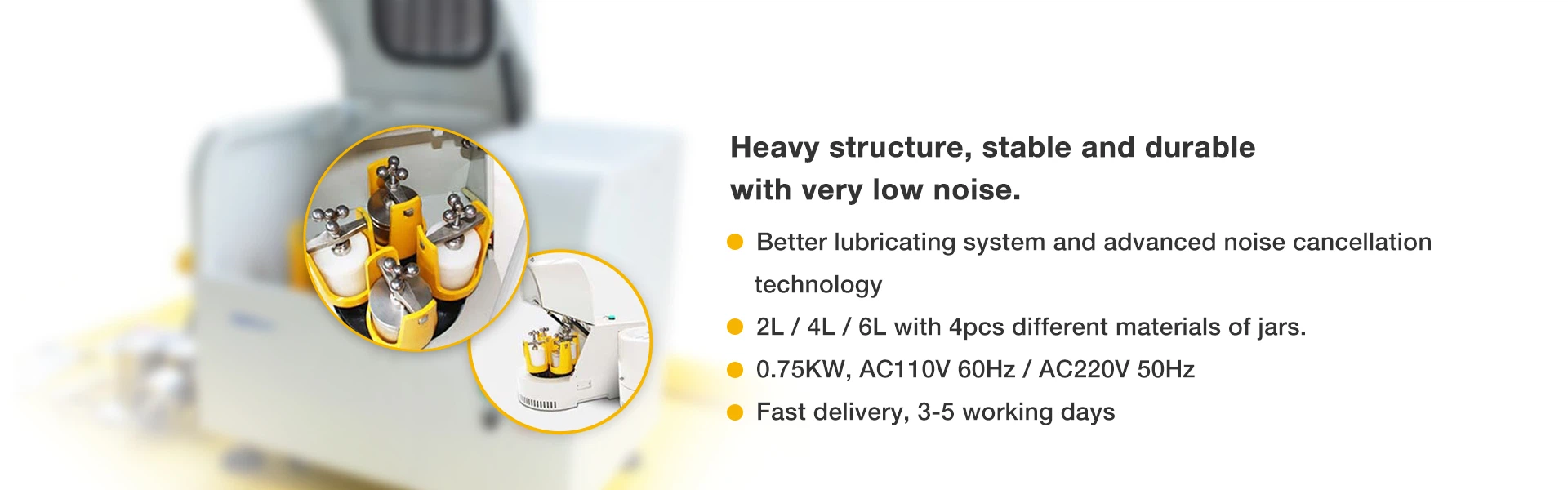


Planetary Ball Mill Machine 0.4L
Working Principle of 0.4L Planetary Ball Milling Machine The 0.4L planetary ball milling machine operates based on the planetary motion principle , which combines rotation and revolution to generate high-energy impact, friction, and shearing forces for material grinding. The machine consists of...
Description
Working Principle of 0.4L Planetary Ball Milling Machine
The 0.4L planetary ball milling machine operates based on the planetary motion principle, which combines rotation and revolution to generate high-energy impact, friction, and shearing forces for material grinding. The machine consists of a rotating main shaft (revolution axis) and multiple grinding jars mounted on a turntable. When the main shaft rotates, the turntable drives the grinding jars to revolve around the main axis at a certain speed; simultaneously, each jar rotates in the opposite direction around its own axis (rotation). This dual-motion design creates a centrifugal force several times greater than gravity (up to 40G), causing the grinding balls inside the jars to impact, roll, and rub against the raw materials violently. Under the combined action of these mechanical forces, the materials are gradually crushed into ultra-fine powders, even reaching nanometer scale. The closed-loop grinding environment ensures no contamination, while the adjustable rotation/revolution speed ratio allows precise control of grinding intensity.
Application Scenarios
The 0.4L planetary ball mill is a versatile laboratory-scale equipment widely used in various fields requiring ultra-fine grinding, mixing, or homogenization of small-batch materials (sample volume: 50-300mL). Key application scenarios include:
Material Science & Nanotechnology: Preparation of nano-powders (e.g., TiO₂, ZnO, carbon nanotubes), alloy powders, and composite materials.
Chemistry & Chemical Engineering: Grinding of catalysts, pharmaceutical intermediates, organic/inorganic compounds, and reaction precursors.
Metallurgy & Minerals: Fine grinding of metal oxides, ore samples, and rare earth materials for elemental analysis or material modification.
Ceramics & Glass: Preparation of ceramic slurries, glass powders, and refractory materials with uniform particle size distribution.
Biology & Food Industry: Grinding of plant samples, food additives, and biological powders (with corrosion-resistant jars).
Academic Research & Laboratory Testing: Small-batch experiments, process optimization, and sample preparation for material characterization (e.g., XRD, SEM).
Technical Parameters
|
Parameter |
Specification |
|
Effective Volume |
0.4L (per grinding jar; optional 2-4 jars configuration) |
|
Grinding Jar Material |
Zirconia (Y-TZP), alumina, stainless steel, tungsten carbide, agate, PTFE (for acid/alkali-resistant applications) |
|
Grinding Ball Diameter |
3-10mm (zirconia, alumina, stainless steel, etc., optional) |
|
Revolution Speed |
0-550 rpm (stepless adjustable) |
|
Rotation Speed |
0-1100 rpm (rotation/revolution ratio = 2:1, optimized for grinding efficiency) |
|
Maximum Centrifugal Force |
40G |
|
Power Supply |
AC 220V/50Hz or 110V/60Hz, 500W |
|
Working Temperature |
0-40℃ (ambient; optional water cooling system for high-temperature grinding) |
|
Timer Range |
0-999 minutes (automatic shutdown after completion) |
|
Machine Dimension (L×W×H) |
500×300×300 mm |
|
Net Weight |
28 kg |
|
Safety Features |
Overload protection, emergency stop button, anti-slip base, sealed jar lids (preventing powder leakage) |
Typical Grinding Cases
Case 1: Nano-Titanium Dioxide (TiO₂) Grinding
Raw Material: TiO₂ coarse powder (particle size: 5μm), 100g per jar.
Grinding Configuration: Zirconia jar (0.4L) + zirconia balls (5mm diameter, ball-to-material ratio = 5:1).
Process Parameters: Revolution speed = 300 rpm, rotation speed = 600 rpm, grinding time = 4 hours (intermittent: 30 mins grinding + 10 mins rest to avoid overheating).
Result: Final particle size = 80nm (D50), particle size distribution CV purity (no contamination from jar/balls).
Case 2: Alloy Powder (Al-Si) Mixing & Grinding
Raw Material: Aluminum powder (200 mesh) + silicon powder (300 mesh) in a mass ratio of 9:1, total 150g per jar.
Grinding Configuration: Stainless steel jar + stainless steel balls (8mm diameter, ball-to-material ratio = 4:1).
Process Parameters: Revolution speed = 350 rpm, rotation speed = 700 rpm, grinding time = 3 hours (continuous).
Result: Homogeneous Al-Si alloy powder with particle size = 2μm (D50), uniform element distribution (verified by EDS analysis).
Hot Tags: planetary ball mill machine 0.4l, China, manufacturers, suppliers, factory, price, principle, for sale


