

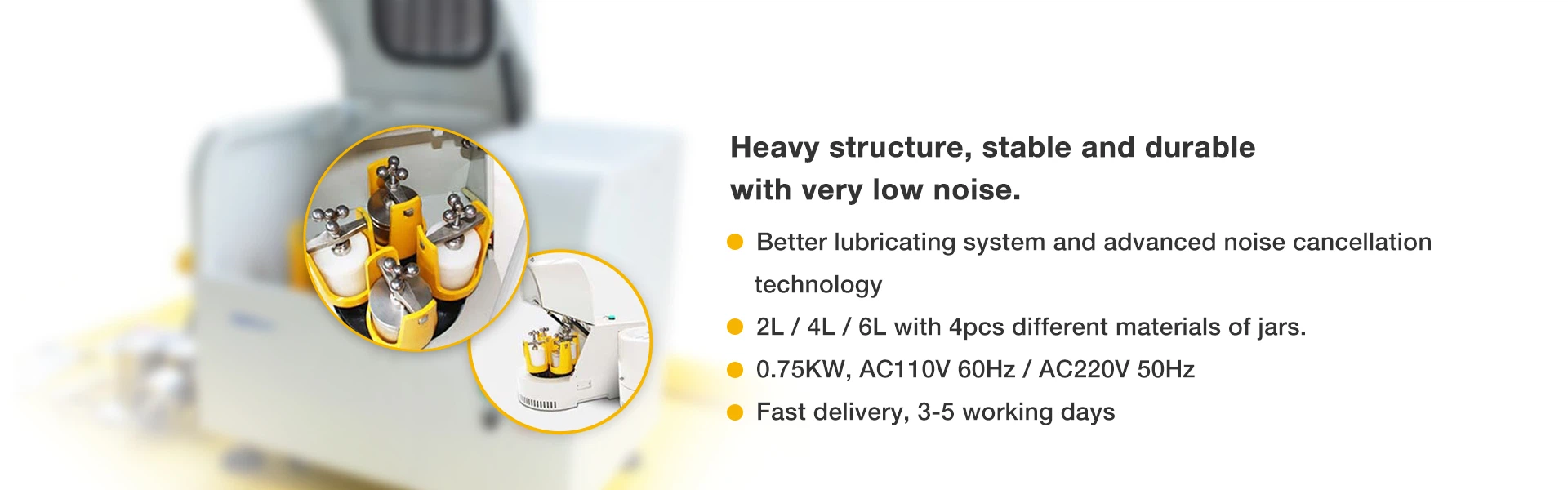


High Energy Planetary Ball Mill
The high-energy planetary ball mill is a cutting-edge grinding equipment renowned for its exceptional grinding efficiency and ability to achieve nano-scale particle sizes. Unlike conventional ball mills, it leverages high centrifugal force generated by dual rotational movements to deliver...
Description
The high-energy planetary ball mill is a cutting-edge grinding equipment renowned for its exceptional grinding efficiency and ability to achieve nano-scale particle sizes. Unlike conventional ball mills, it leverages high centrifugal force generated by dual rotational movements to deliver intense impact and shear forces, making it indispensable in materials science, nanotechnology, and industrial research. Below is a detailed breakdown of its working principle, structural design, technical specifications, and practical grinding cases.
Working Principle
The core principle of a high-energy planetary ball mill lies in the synchronous rotation and revolution of grinding jars, which creates ultra-high centrifugal acceleration to drive grinding media (e.g., balls) into violent motion. Here's the step-by-step mechanism:
Dual Rotational Motion: The machine's main shaft (revolution axis) drives the turntable to rotate at a set speed (typically 50-400 rpm). Meanwhile, each grinding jar mounted on the turntable rotates in the opposite direction (rotation axis) at a higher speed (100-800 rpm), forming a "planetary motion" similar to celestial bodies.
Centrifugal Force Generation: This dual motion generates enormous centrifugal force (20-100 times gravitational acceleration, g), far exceeding that of standard ball mills. The grinding media inside the jars are accelerated outward by this force.
Intense Grinding Action: Under the combined effect of centrifugal force and gravity, the grinding media undergo three types of motion: impact (colliding with the jar walls and sample), friction (sliding against each other), and shear (shearing the sample particles). These actions break down the sample into micro- or nano-scale particles efficiently-some models can achieve particle sizes as small as 10 nm.
Energy Transfer: The high kinetic energy of the grinding media is directly transferred to the sample, enabling not only particle size reduction but also mechanochemical reactions (e.g., alloy formation, phase transitions) that are difficult to achieve with conventional equipment.
Structural Components
A high-energy planetary ball mill consists of several key components, each designed to ensure stability, efficiency, and safety during high-intensity operation:
|
Component |
Function |
Key Design Features |
|
Turntable (Revolution Platform) |
Drives grinding jars to revolve around the main axis |
Made of high-strength cast iron or aluminum alloy; balanced design to reduce vibration; equipped with precision bearings for smooth rotation |
|
Grinding Jars |
Holds sample and grinding media; rotates independently |
Volumes range from 0.1L to 5L (laboratory models); materials include stainless steel, zirconium oxide, agate, and PTFE (to avoid contamination); sealed with O-rings for leak-proof operation |
|
Rotation Shafts |
Connect grinding jars to the turntable; enable reverse rotation |
High-torque design to withstand high centrifugal force; corrosion-resistant coating for long service life |
|
Motor & Transmission System |
Provides power for revolution and rotation |
High-efficiency AC motor (1.5-11 kW); gearbox or belt drive for precise speed control; variable frequency drive (VFD) to adjust speed continuously |
|
Control Panel |
Manages operational parameters |
Digital display for speed, time, and temperature; programmable settings (up to 99 cycles); emergency stop button and overload protection |
|
Base & Vibration Dampeners |
Supports the entire machine; reduces vibration |
Heavy-duty steel base for stability; rubber or spring dampeners to minimize noise (≤75 dB) and protect the workbench |
|
Cooling System (Optional) |
Prevents overheating during long grinding sessions |
Water-cooled or air-cooled design; temperature control range: -20℃ to room temperature; suitable for heat-sensitive samples |
Technical Specifications of UBE-V0.4L
|
Parameter |
Range (Laboratory Models) |
|
Revolution Speed |
50-400 rpm |
|
Rotation Speed |
100-800 rpm (2× revolution speed for most models) |
|
Centrifugal Acceleration |
20-100 g |
|
Grinding Jar Volume |
0.05L,0.1L (multi-jar configurations available: 2-4 jars) |
|
Motor Power |
0.25 kW |
|
Maximum Sample Capacity per Jar |
30-45% of jar volume (e.g., 0.03L for 0.1L jar) |
|
Grinding Media Size |
0.5-20 mm (zirconium oxide, stainless steel, agate, etc.) |
|
Grinding Time Setting |
1-9999 minutes (continuous or intermittent operation) |
|
Operating Voltage |
110V/220V (single-phase) |
|
Dimensions (L×W×H) |
600×300×400 mm (varies by capacity) |
|
Net Weight |
50 kg |
|
Optional Configurations |
Vacuum jars, cooling system, inert gas protection, touchscreen control |
Grinding Cases
Case 1: Nano-Grinding of Titanium Dioxide (TiO₂) for Photocatalytic Applications
Objective: Reduce commercial TiO₂ powder (average particle size: 25 μm) to nano-scale (≤50 nm) to enhance its photocatalytic activity.
Equipment Configuration: 2L zirconium oxide grinding jars; 5 mm zirconium oxide grinding media; cooling system (set temperature: 10℃); inert gas (argon) protection to prevent oxidation.
Operational Parameters: Revolution speed: 150 rpm; rotation speed: 300 rpm; grinding time: 4 hours (intermittent: 30 minutes grinding + 10 minutes cooling); media-to-sample ratio: 5:1 (by weight).
Result: The processed TiO₂ powder achieved an average particle size of 38 nm, with a specific surface area increased from 10 m²/g to 85 m²/g. Photocatalytic tests showed a 300% improvement in methylene blue degradation efficiency compared to the original powder.
Case 2: Mechanochemical Synthesis of Lithium Iron Phosphate (LiFePO₄) Cathode Material
Objective: Synthesize LiFePO₄ directly from raw materials (Li₂CO₃, Fe₂O₃, (NH₄)₂HPO₄) via mechanochemical reaction, eliminating the need for high-temperature calcination.
Equipment Configuration: 1L stainless steel grinding jars; 10 mm stainless steel grinding media; vacuum-sealed jars to avoid moisture absorption.
Operational Parameters: Revolution speed: 180 rpm; rotation speed: 360 rpm; grinding time: 6 hours; raw material ratio: Li₂CO₃:Fe₂O₃:(NH₄)₂HPO₄ = 1:1:2 (molar ratio); media-to-material ratio: 10:1 (by weight).
Result: X-ray diffraction (XRD) analysis confirmed the formation of pure LiFePO₄ phase with no impurities. The synthesized material had a particle size of 1-2 μm and exhibited excellent electrochemical performance: initial discharge capacity of 158 mAh/g at 0.1C rate, with 95% capacity retention after 500 charge-discharge cycles.
Hot Tags: high energy planetary ball mill, China, manufacturers, suppliers, factory, price, principle, for sale


