



Laboratory Ball Milling Machine Price
Laboratory Ball Milling Machine Price Overview Laboratory ball milling machines are essential equipment for material grinding in research and small-scale production, with prices varying significantly based on capacity, configuration, and technical performance. The market price range typically...
Description
Laboratory Ball Milling Machine Price Overview
Laboratory ball milling machines are essential equipment for material grinding in research and small-scale production, with prices varying significantly based on capacity, configuration, and technical performance. The market price range typically spans from USD 1400 to USD 12,000 per unit . Entry-level mini models (0.2L-0.4L) designed for basic laboratory use start at approximately USD 1400-1800, such as the bench-top ceramic jar mill priced at USD 1200-1680 with a 2-year warranty . Mid-range models (1L-5L) suitable for standard research applications range from USD 1,150 to USD 2,686, including planetary ball mills with variable speed control and multi-purpose grinding capabilities . High-performance units with advanced features (e.g., cooling systems, vacuum chambers, or nano-grinding functions) cost between USD 3,000 and USD 5,500, while industrial-grade laboratory models for pilot-scale production can reach up to USD 12,000 . Most suppliers offer 1-5 year warranties, with minimum order quantities typically set at 1 unit .
Key Technical Parameters
The operational efficiency and application scope of laboratory ball milling machines are defined by core technical specifications:
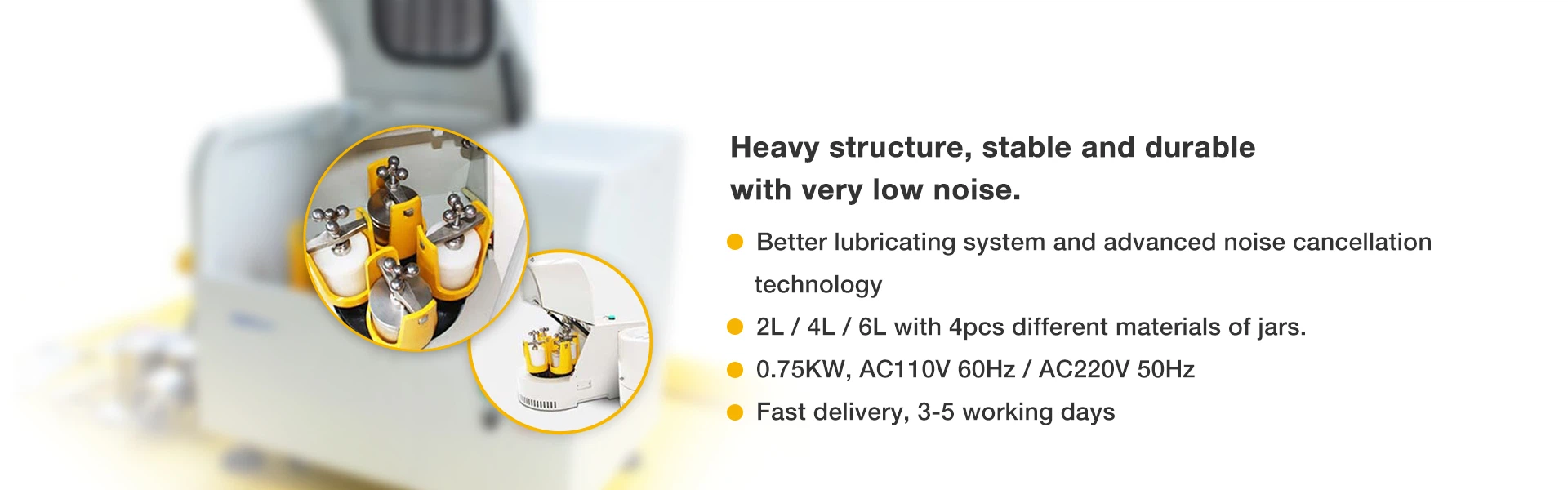
Capacity & Volume: Ranges from 0.1L (miniature models) to 100L (large-scale laboratory units), with common sizes including 0.4L, 2L, 5L, and 20L to accommodate different sample quantities . Recommended loading volume is 30-45% of the jar capacity for optimal grinding efficiency .
Rotational Speed: Standard models offer 0-400 rpm, high-speed versions reach 0-800 rpm (ideal for nano-material processing), and industrial laboratory models operate at 20-80 rpm for stable large-batch grinding .
Motor Power: Varies from 0.75kW (small units) to 11kW (large models), with mid-range machines typically equipped with 1.5-4kW motors to balance performance and energy consumption .
Grinding Media & Jars: Available in materials including stainless steel, agate, zirconium oxide, and PTFE to prevent sample contamination, with jar volumes matching the machine's capacity .
Special Configurations: Advanced models may include cooling systems (-20℃ to room temperature), vacuum chambers (10⁻³Pa vacuum degree), and digital control panels with programmable settings .
Operation Guidelines
Laboratory ball milling machines feature user-friendly operation with safety and efficiency as core design principles:
Preparation: Ensure the machine is connected to a compatible power supply (110V/220V/380V) and place it on a stable surface. Select appropriate grinding media and jars based on material properties (e.g., agate for non-contaminating grinding, stainless steel for hard materials) .
Loading: Fill the grinding jar with the sample and media (30-45% media volume, 1/3-2/3 sample volume) to avoid overloading. Secure the jar tightly to prevent leakage during operation .
Parameter Setting: Use the digital control panel to set rotational speed (adjust based on material hardness) and grinding time (up to 9,999 minutes for extended experiments). For heat-sensitive materials, activate the cooling system and set temperature limits .
Operation: Turn on the cooling fans (if equipped) before starting the machine. Press the start button and monitor operation-normal noise levels should be below 65dB. Avoid unattended operation; stop immediately if abnormal vibrations or overheating occur .
Post-Operation: After grinding completes, turn off the power and allow the machine to cool. Safely remove the jar and collect the processed sample, ensuring proper cleaning of equipment to prevent cross-contamination .
Applicable Industries & Fields
Laboratory ball milling machines are versatile tools widely used across scientific research and industrial sectors:
Academic & Research Institutions: Ideal for materials science, nanotechnology, and chemistry laboratories for sample preparation, particle size reduction, and alloy development .
Mining & Geology: Used for grinding ores, soil samples, and mineral powders in geological surveys and resource analysis .
Pharmaceuticals & Cosmetics: Enables fine grinding of active pharmaceutical ingredients (APIs), pigments, and cosmetic powders for controlled release formulations and UV-protective products .
Chemical & Materials Engineering: Suitable for processing ceramics, polymers, and composite materials, as well as dispersion of nano-particles for advanced applications .
Food & Agriculture: Used for grinding food additives, agricultural samples, and feed materials in quality control and research .
Environmental Testing: Facilitates analysis of heavy metals and pollutants in soil and water samples through efficient grinding and homogenization .
Photo show:


Pls contact us with email: deco_mill@126.com
Hot Tags: laboratory ball milling machine price, China, manufacturers, suppliers, factory, price, principle, for sale


