how to calculate ball mill speed
May 08, 2024
The speed of a ball mill, often referred to as the critical speed, is calculated using a formula. This critical speed can be calculated by taking the square root of the radius of the mill (in meters) multiplied by the gravitational acceleration (9.81 m/s^2) and multiplying it by a constant, usually between 0.5 and 0.75, depending on the type of mill and the size of the media.
The formula for calculating the critical speed of a ball mill is:

Here's a breakdown of the components:
Radius of the mill: This is the distance from the center of the mill to the outer diameter of the mill.
Gravitational acceleration (g): This is typically taken as 9.81 m/s29.81m/s2.
Constant: This constant is typically between 0.5 and 0.75, depending on the type of mill and the size of the media. For most mills, a value of around 0.65 is commonly used.
Once you have these values, plug them into the formula to find the critical speed.
For example, let's say you have a ball mill with a radius of 1 meter and you want to calculate its critical speed using a constant of 0.65:
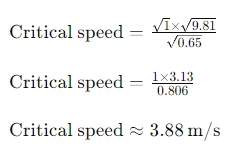
This means that when the ball mill is rotating at a speed of approximately 3.88 meters per second, the centrifugal force on the balls inside the mill will be equal to the gravitational force, allowing the balls to be held against the inner wall of the mill and preventing them from falling down. This speed is important for the efficient operation of the mill and for achieving optimal grinding results.